WEFLO Launches Drone Diagnostics Software ‘FloONE AI Suite’
- Expands AI software coverage from final End-of-Line (EOL) inspection in drone manufacturing to pre-flight checks and maintenance in field operations
- Offered as an integrated package with WEFLO’s ‘DRQC’ and ‘verti-Pit’ inspection systems, targeting drone manufacturers, operators, and the defense sector
- Built on more than 1.04 million mobility inspection records accumulated across more than 292 sites in Korea and overseas
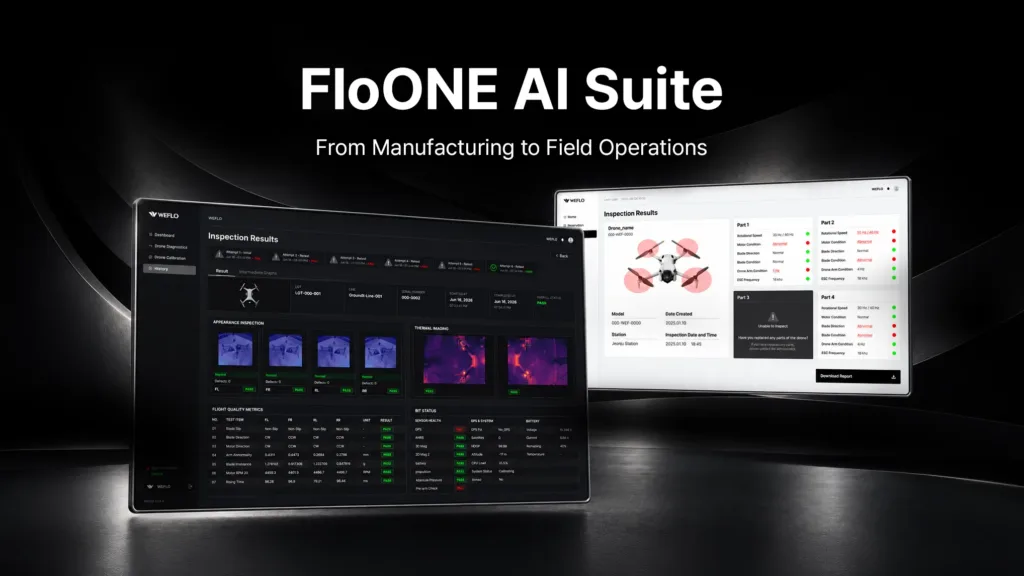
WEFLO, an AI-powered mobility diagnostics company, has launched FloONE AI Suite, an AI software platform that supports the full inspection workflow from final production-line inspection to pre-flight checks and maintenance in field operations.
The software uses AI to analyze multiple signal data streams collected by WEFLO’s inspection equipment, detecting anomalous patterns that are difficult to identify through individual signals or fixed thresholds alone. The dashboard provides pass/fail determinations, identifies anomalous components, and displays inspection and maintenance histories. FloONE AI Suite expands the AI software capabilities of FloONE, WEFLO’s platform introduced in June to support the transition to dark factories, from manufacturing into operational environments.
FloONE AI Suite is supplied as a package with WEFLO’s inspection equipment. Its primary customers include drone manufacturers seeking consistent outgoing quality, drone operators managing large fleets on a daily basis, and defense organizations where aircraft availability and mission reliability are critical.
The manufacturing software integrates with WEFLO’s DRQC series of End-of-Line inspection systems. It records inspection and calibration results for propulsion components including motors, ESCs (Electronic Speed Controllers), and blades, as well as machine-vision exterior inspection, thermal imaging, IMU (Inertial Measurement Unit), and magnetometer sensors, by individual aircraft serial number.
The software also visualizes first-pass yield, rework rate, major defect categories, and quality trends by production line. Inspection reports are generated automatically, while integration with existing MES (Manufacturing Execution Systems) and aircraft BIT (Built-in Test) data enables deployment without replacing existing production infrastructure.
The operations software integrates with WEFLO’s verti-Pit series of automated pre-flight inspection pads. Field operators can complete required pre-flight inspections through a digital checklist and review diagnostic results for major aircraft components.
Flight schedules and reservations, along with aircraft-specific inspection and maintenance histories, can also be managed through a single dashboard. Accumulated condition-change data provides a basis for determining appropriate maintenance timing.
FloONE AI Suite was developed using inspection data accumulated directly by WEFLO across real-world operating environments. In connection with a drone demonstration program led by Korea’s Ministry of Land, Infrastructure and Transport (MOLIT), WEFLO has established 45 drone delivery hubs and 177 delivery points nationwide and installed and operated 34 automated pre-flight inspection pads.
Combined with data from military combat experimentation and demonstration projects, drone manufacturing and operations sites in the United States, maritime drone operations, and vehicle inspection sites, WEFLO has accumulated data from more than 3,000 drone flights and demonstrations across over 292 sites in Korea and overseas, as well as more than 1.04 million mobility inspection records.
“Through inspection data accumulated across nationwide drone delivery operations, domestic and international manufacturing sites, and defense demonstration environments, we confirmed that reliability at scale cannot be achieved when factory quality data and field maintenance data remain disconnected,” said Yeejung Kim, CEO of WEFLO.
“We will continue to advance FloONE AI Suite so that inspection results at the time of shipment can be connected with changes in aircraft condition after deployment, allowing the entire lifecycle of a drone—from production through mission completion—to be managed through a single data framework.”