Why do drones crash?
The real causes, according to the data.
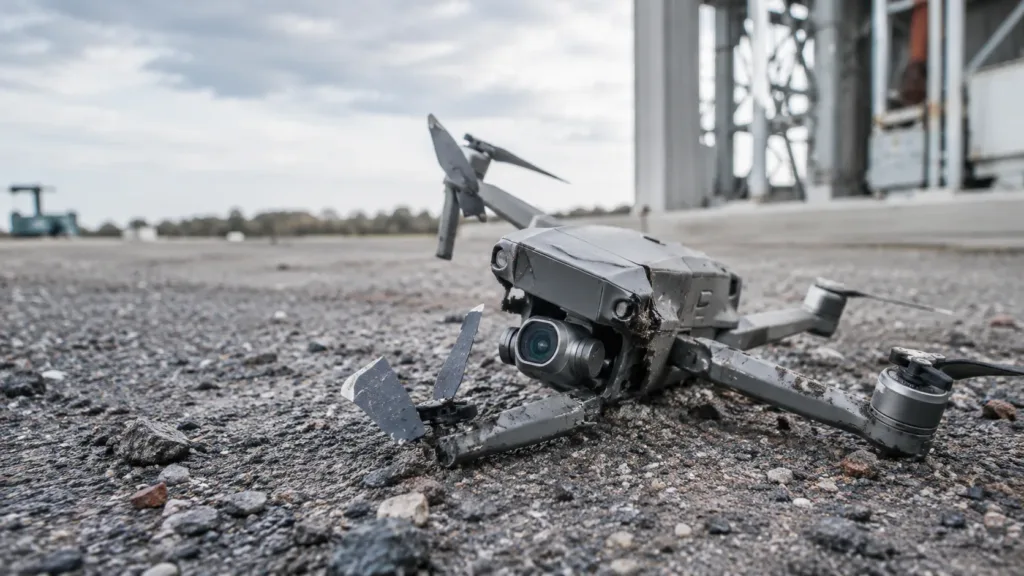
Have you ever pictured a drone suddenly stopping in mid-air? When a car breaks down, you can pull over to the shoulder. A drone cannot. If a single part fails in flight, the result is an immediate crash. That is what makes drone accidents so dangerous.
So why do drones crash? Most people think first of strong winds or pilot error. But the accident record tells a different story. One study that analyzed 319 multirotor drone accidents worldwide between 2016 and 2022 found that internal technical faults, not external factors like weather, accounted for about two-thirds of the causes (67.4%).
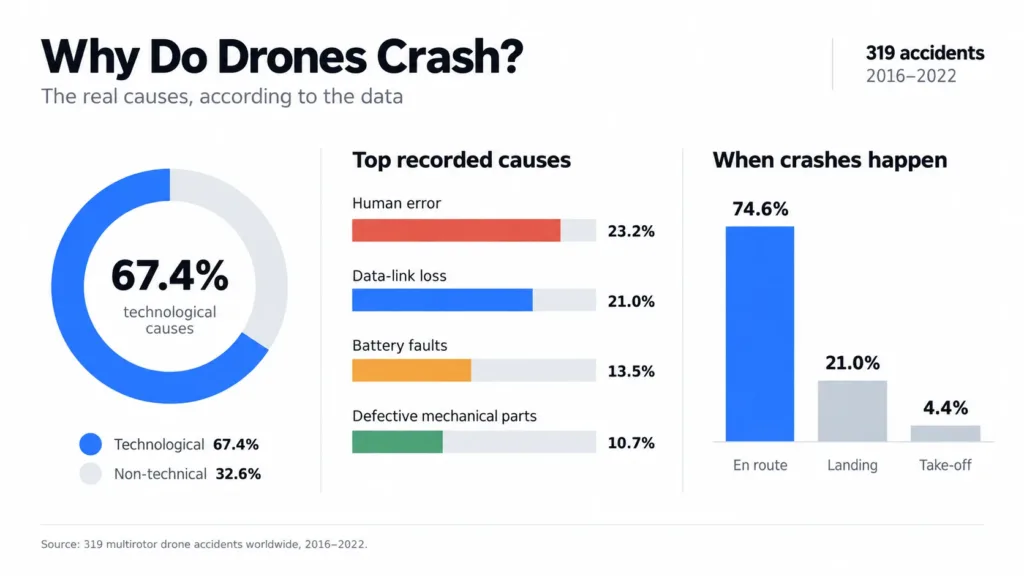
Break those causes down and it gets interesting. Human error was the single most common at 23.2%, but data-link loss (21.0%), battery faults (13.5%), and defective mechanical parts (10.7%) followed close behind. In other words, drones were failing on their own about as often as their operators slipped up, if not more. A motor slightly out of balance, a hairline crack in the frame, a battery cell that has lost its charge: on the ground each looks trivial, but in the air any one of them can turn into a serious accident.
And when do most accidents happen? In the same study, 74.6% occurred while the drone was en route, against 21.0% on landing and just 4.4% on take-off. That is the reverse of crewed aviation, where accidents cluster around take-off and landing. A drone usually lifts off cleanly, then goes down in the middle of its mission. Once it is airborne and something goes wrong, there is little time left to react.
The catch is that most of these faults look perfectly normal before take-off. A hairline crack, a slightly skewed balance, a slowly degrading battery: none of it shows on the surface. Inspection that leans on a skilled technician’s eyes and hands misses these signs easily, and the verdict shifts depending on who is looking. The defect is there. It simply is not visible.
So the question is shifting. Not “how do we fly more carefully,” but “how do we catch the invisible before it takes off.” A crash is rarely sudden bad luck. More often it is the result of signals the aircraft was already sending that no one managed to read. Whether those signals can be read as data is where drone safety will be decided.
Sources: Cross-National Statistical Analysis of Multi-Rotor UAS Accidents (2016–2022), Computation 2025