How Many Inspection Points Does a Single Drone Have?
From propulsion to battery, what actually needs to be checked
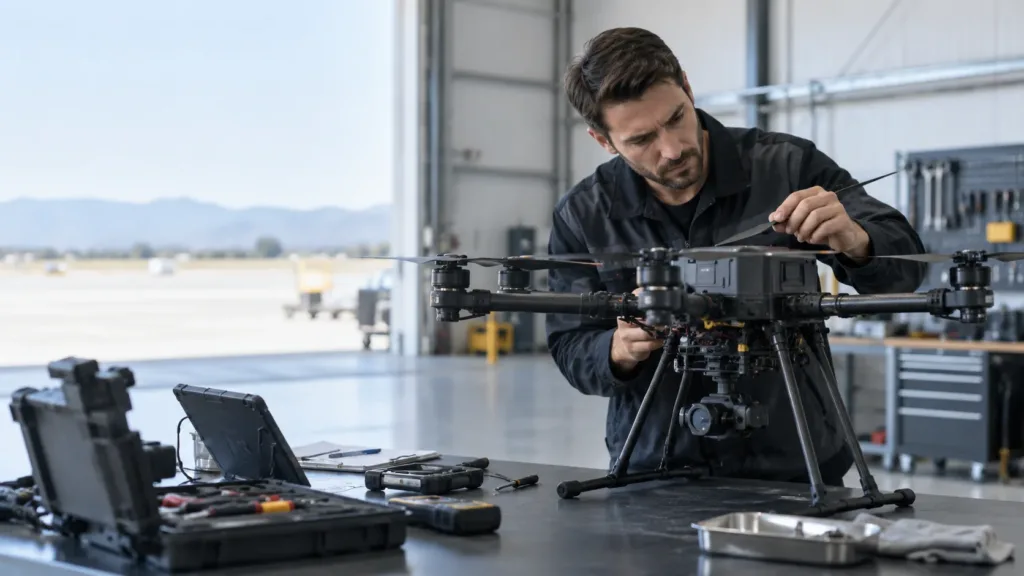
What does it really take to inspect a single drone properly, and how many points do you need to check? On the surface there is not much more than the propellers and the body, but once you break the aircraft down by the parts that directly affect flight, the list of things to verify turns out to be far longer. It falls into four main areas.
The first is the propulsion system. This is what actually gets the aircraft airborne, and the number of motors varies by type: four on a quadcopter, six on a hexacopter, eight on an octocopter. Judging the condition of a single motor means measuring its rotation speed, response time, vibration, and balance individually, along with checking propeller balance and bearing wear. The more motors an aircraft has, the more inspection points scale up in proportion.
The second is the structure. This covers the arms and frame that support the motors, along with the fasteners that hold them together. Structural damage often does not show early. Repeated vibration and load can create fine cracks in an arm or gradually loosen a fastener, and either can translate into instability in flight. That is why a normal-looking exterior still needs to be verified separately.
The third is the electronics. This is where the flight controller (FC) that commands the aircraft and its various sensors are concentrated: the IMU (accelerometer and gyroscope) that controls attitude, the magnetometer that determines heading, and the GPS and communication modules that establish position. Here, what matters is not only whether a component works, but how accurate its readings are. Even a small sensor error can cause the aircraft to misjudge its own attitude or heading.
The last is the battery. Its condition cannot be assessed from the outside, so the internal parameters have to be checked on their own: cell voltage balance, internal resistance, heat generation, state of health (SoH), BMS operation, and connector integrity. Most of these are invisible to the eye, yet none of them are unrelated to safety.
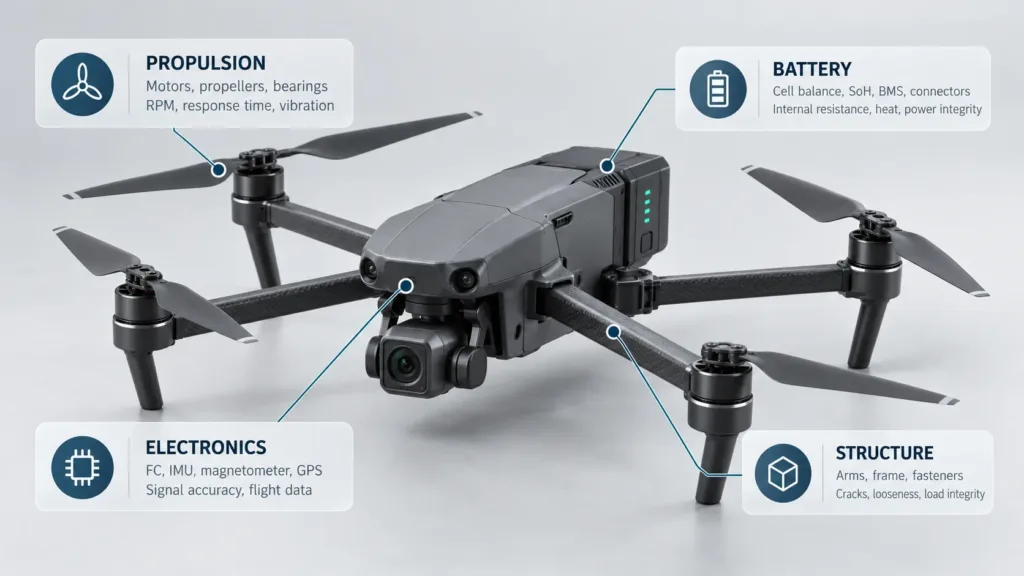
Add these four areas together and a single drone amounts to dozens of inspection points. Those points are not independent; they are connected. A weakening battery increases the load on the motors, and motor vibration affects sensor readings. Checking only some of them cannot guarantee the state of the aircraft. Only when all of the dozens of points are inspected every time, without omission, and against the same standard can the safety of that aircraft be determined. The core challenge of drone inspection is not the difficulty of finding a defect, but the discipline of checking this many items consistently and completely.