- With AI acting beyond thinking AI... Autonomous drone recognition, judgment, and behavior
- From wildfire extinguishing to 3D printing, do your job on your own with every word of human command
- The key to lightening beyond the battery and weight wall is "a solution that will expand the limits of human space."
A forest fire broke out. Orders are given to the drone cluster. "Go out and evolve."
The drones detect the location of the fire on their own, coordinate flight paths with each other, and determine where to drop the water. A man has only given orders. This is what happens when physical AI is combined with drones.
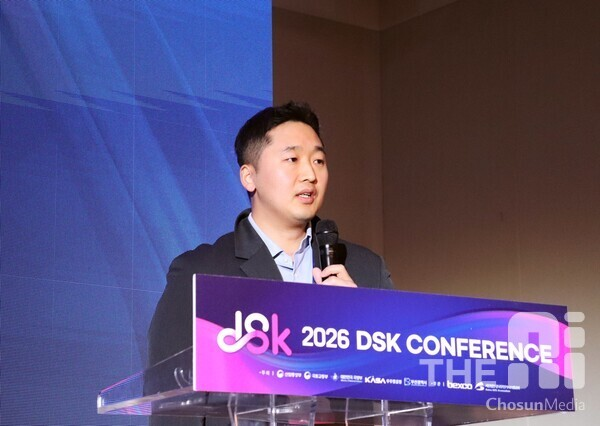
"If you understand drones as winged robots, you can easily grasp what physical AI is," said Jeongwan Koh, co-founder and COO at the "2026 DSK Conference" held in BEXCO, Busan on the 25th. A graduate of KAIST's electronics department and researched medical AI at Harvard Medical School, he predicted that the combination of physical AI and drones will solve problems in three-dimensional spaces that humans have not been able to reach.
◇ AI is off the screen... The difference between software AI and physical AI
COO Koh explained the concept of physical AI by comparing it with an automobile mechanic. The technician communicates with the customer, diagnoses the condition of the vehicle, makes a maintenance plan, and takes the tool and repairs it himself. In this process, diagnosis and judgment are the responsibility of software AI that occurs in the head. Physical AI is in charge of picking up the tool and releasing the bolt.
"Existing AI, such as ChatGPT, is a software AI that receives text or images and outputs digital data," COO Koh said. "Physical AI goes one step further from here and recognizes space and outputs actual physical actions."
According to his explanation, physical AI works in three stages. It is a 'perception' that recognizes the surrounding environment with various sensors such as cameras, GPS, and LiDAR, a 'decision' that makes a judgment based on that information, and an 'action' that translates judgment into actual action. These three steps are constantly repeated and return to real-time. The representative industry that shows this structure is drones.
◇ Drone Becomes a Winged Robot
In the existing drones, humans designated routes one by one. You had to enter coordinates on each route to your destination and instruct where to turn right. Drones equipped with physical AI are different. If you say, "Follow that building," the drone will fly by itself, judging obstacles and creating routes. Research is already underway in which only natural language commands are entered into FPV (first-person perspective) drones and the rest are handled by drones themselves.
DJI is the most actively promoting physical AI in the drone industry. DJI recently released 'Manifold 3', an onboard computing chip for drones. It is a chip that can drive the small language model (sLLM) directly inside the drone, and the intention is to put an advanced AI model that goes beyond simple object recognition and extends from cognition to behavior on the drone. DJI is also running a challenge to develop AI algorithms for drones and growing the physical AI ecosystem.
Cluster drones are an area that shows the potential of physical AI. When one operator entrusts multiple drones with reconnaissance and strike missions, the drones divide their roles and judge and act on their own. There is also a drone 3D printing study conceived from the method of building a honeycomb. The drone cluster scans the outer wall of the building and outputs the structure directly from the air. An era is opening in which drones work instead in a space that is difficult for humans to access.
◇ Advancement and lightening, two rabbits... "It's actually hard"
The wall to overcome is as high as the possibility. The biggest challenge for physical AI drones is that they must simultaneously achieve the advancement and weight reduction of AI models. The more sophisticated AI becomes, the more computations are needed, and the more computations are, the greater the battery consumption. But drones have to be airborne. The weight is the limit.
Currently, the flying time of the drone is only one to two hours. Batteries account for 30-50% of the total weight. As AI models are advanced, computing needs increase, and then battery consumption increases. In other words, it has much harsher conditions than robots on the ground.
COO Koh said, "Honestly, there is also a thought that it is not easy." Just as smart glasses have been stuck in place for a long time due to hardware limitations, drone physical AI can also hit the same wall if the battery and weight reduction problems are not solved.
Nevertheless, he stressed that the direction itself is clear. "If humanoid robots replace what humans used to do, physical AI drones can solve problems in three-dimensional space that humans could not do," he said. "The combination of drones and physical AI will be a solution that redefines human possibilities and expands the scope of what can be done."
